The agentic IDE

Run agents in parallel.
Merge what they build.

Write what you want. Hand it to Claude Code, Codex or any agent CLI on its own worktree. Watch every agent by what needs you, review the diff, and merge. One window, no tab juggling.

View on GitHub →

macOS and Linux · Free and MIT licensed

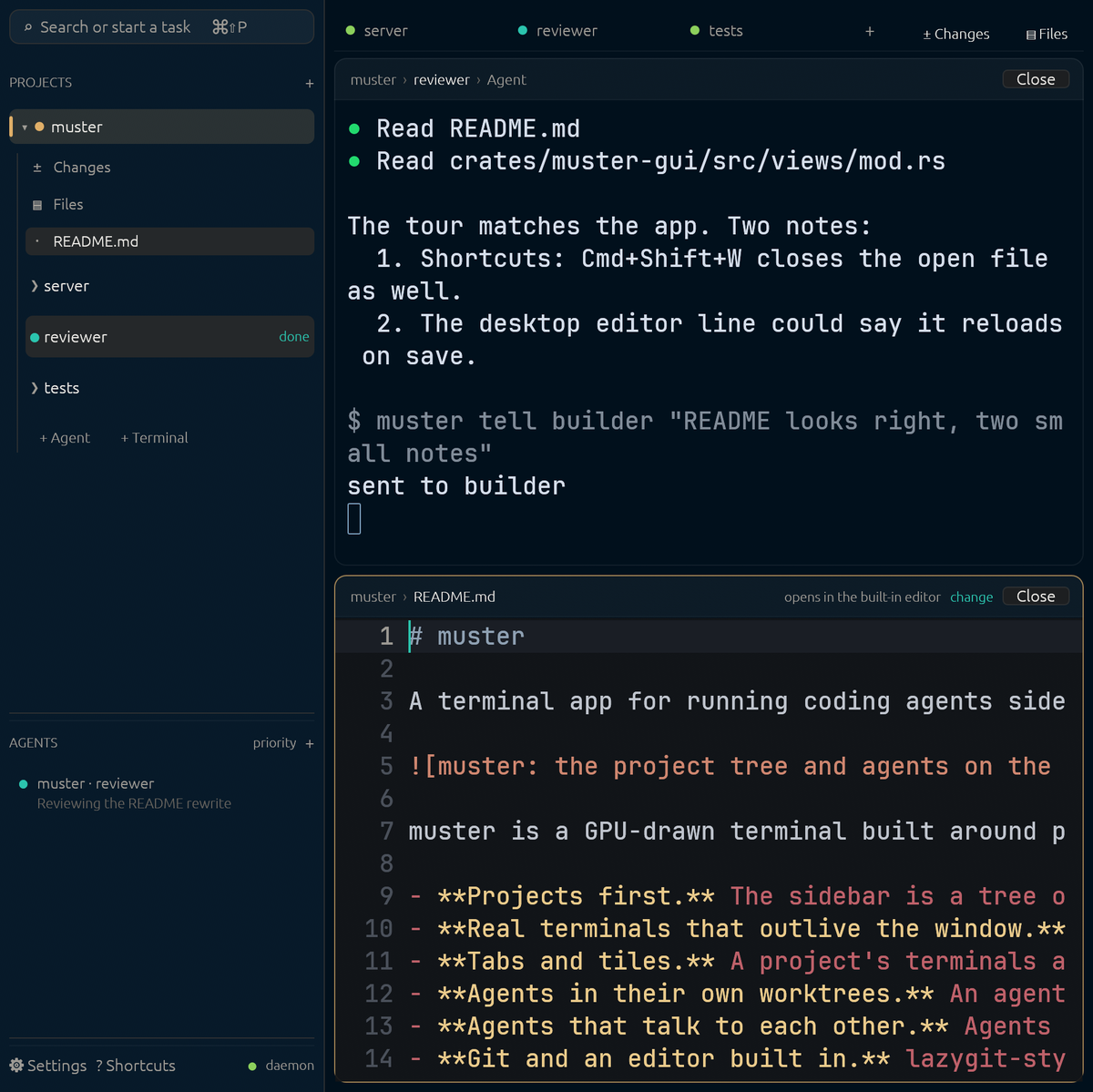
pitwall: projects and agents in the sidebar, an agent and a file open in two tiled cards
add-metrics wants to run npm installApprove
reviewer · done +124 −18
fix-login · working brief 3/5

Running agents today

Five tools and a memory test.

Agents edit the same checkout and trip over each other. Reviewing means reading a diff and retyping your notes into a prompt.
pitwall puts the whole loop in one window.

The loop

Brief. Build. Review. Ship.

01

Write the brief.

Start from a template made for agent work: feature, bug, refactor, UI polish, spike. Type the ask in your own words, then hit ✦ Finish with AI. Claude reads your code and fills in the problem, the files, the steps and the open questions while you watch it write.

briefs › fix-login-redirect.md✦ reading src/auth.rs

# Fix the login redirect loop

Ask: after signing in on Safari we bounce straight back to /login.

## Cause

## Steps

- [x] Reproduce with a failing test

- [x] Set SameSite=Lax on the session cookie

- [ ] Check expiry in is_valid()

StopHand to agent →
02

Hand it to an agent.

Every agent starts on its own git worktree and branch. Run as many as you like: they never touch your checkout or each other's. The agent ticks off each step of the brief as it goes.

mainyour checkout · untouched
pitwall/fix-loginclaude
pitwall/add-metricscodex
pitwall/docs-tourclaude
pitwall/flaky-testsopencode
03

See who needs you.

Every agent in every project, sorted by what needs you: waiting on an approval, asking a question, done, working. Each row shows how far through its brief it is and how much it has changed. Answer a numbered prompt right from the sidebar.

AGENTS priority
pitwall · add-metricsapprove: npm install --save-dev jest
approve
augur · apiReuse the existing cache layer?1 Yes2 No
pitwall · reviewer6 files +124 −18
done
pitwall · fix-loginFix the login redirect loop · 3/5
04

Review like a lead, not a typist.

Read the agent's diff against where it started. Comment on any line, then send every comment back as one message for its next turn. Throw away a hunk you don't want. Every step it took is a snapshot you can revert to.

fix-login · vs basesend 2 to agent
11  pub fn is_valid(&self) -> bool {
12-     self.token.is_some()
12+     self.token.is_some() && self.expires_at > now()
13  }
14
15+ fn now() -> u64 {
16+     SystemTime::now().duration_since(UNIX_EPOCH)
💬 you Use the clock from util::time so the tests can fake it.
05

Accept. Merged.

One step commits what the agent left, merges its branch into the one it came from, and offers to clean up the worktree, snapshots and branch. pitwall checks your checkout is clean first, so nothing lands on top of your own work.

✓ Accept fix-login
Fix the login redirect loop
pitwall/fix-login→main
CancelCommit & merge

Safety

Guardrails that only tighten.

pitwall never quietly allows a command on its own reading of the shell. It denies what your rules deny, queues what needs a look, and leaves the rest to the agent's own prompt.

mutating add-metrics wants to run npm install --save-dev jest && cargo test viewApprove ⌘⇧YReject ⌘⇧R
✕ refusedcargo test && rm -rf ~each part judged on its own, strictest answer wins

Deny rules hold everywhere

Behind sudo, FOO=1, git -C dir, and inside bash -c '…'.

A snapshot before every step

A shadow-git timeline for each agent. Diff any step, revert to it, undo the revert.

#5#4#3 ↺#2#1

Your text is safe

An agent rewrites a file you have open? The version before is one ⌘Z away.

Agents together

Agents that talk to each other.

Every pitwall terminal has the pitwall command on its PATH. Agents list, message, wait on and read one another, so a builder can hand off to a reviewer without you in the middle.

builder
$ pitwall agents
  ● builder    working   ~/code/app
  ● reviewer   idle      ~/code/app
$ pitwall tell reviewer "check the login fix, then tell me"
  sent to reviewer
$ pitwall wait reviewer
$ pitwall read reviewer -n 4
  [message from agent reviewer] Looks right. Two small
  notes on the cookie flags, left as comments.

Remotes

Every server, side by side.

Your SSH servers live in the sidebar, in groups you make. Open one, or the whole group tiled together, and type into all of them at once. Agents running on a server show up in your list with the rest.

ProjectsRemotesKeys+
Connect allRun…
▾Home lab2
build box192.168.50.226
nas192.168.50.59
▾Work1
staging10.0.0.42
▸Ungrouped3
AGENTS priority
build box · claudeFix the flaky deploy script
remote
Broadcasting input to 3 terminalsStop broadcasting
Remote › build box
$ sudo apt upgrade -y
Remote › nas
$ sudo apt upgrade -y
Remote › staging
$ sudo apt upgrade -y

Your ssh, your config

Sessions run your own ssh, so ProxyJump and your agent work. Hosts in ~/.ssh/config show up on their own; add others in the app.

One command, every box

Run… sends a command to a group and shows each server's exit code and output. Anything that changes things asks first.

Agents on servers too

A claude running on a server is read off its screen and listed as build box · claude, marked remote.

Underneath

And it's a real terminal.

Drawn on the GPU. Agents run in their own TUIs, with your shells, vim and lazygit tiled beside them.

Close the window. Nothing stops.

A background daemon owns every terminal. Quit the app and your agents keep working. Restart the machine and they come back in their folders and pick up their sessions.

Tabs and tiles

Split, drag, swap and resize cards. Broadcast typing to all of them.

Git built in

lazygit's layout and keys: stage hunks, commit, check out, all in the window.

Your editor, or ours

A built-in editor that reloads live, or nvim, helix, VS Code, Cursor, Zed.

Scrollback that survives

Restarts keep it. Narrow a card and the text rewraps instead of getting cut.

Keys that work

kitty keyboard protocol, so Shift+Return is a newline in Claude Code and Codex.

Every language

IME for Chinese, Japanese and Korean. UI in seven languages.

API keys, locked away

Tokens sealed with AES-256-GCM behind their own password. Reveal or copy asks every time; the clipboard clears itself.

OpenAI••••••••1234

An icon for every file

Nerd Font icons for each language in the file tree, bundled so they show with any font.

rstspygomd

Starts clean

No stray shell at launch. Projects, Remotes and Keys each get a tab in the sidebar.

Works with the agents you already use

Claude CodeCodexopencodeGeminiaidergooseamp

Pitwall your agents.

Or from source with Rust 1.80+: cargo install --path crates/pitwall-gui

macOS and Linux. Windows isn't supported yet.